SONICOM

    TRANSFORMING AUDITORY-BASED SOCIAL INTERACTION AND COMMUNICATION IN AR/VR

    Bild


    Immersive audio is our everyday experience of being able to hear and interact with sounds around us. Simulating spatially located sounds in virtual or augmented reality (VR/AR) must be done in a unique way for each individual and currently requires expensive, time-consuming individual measurements, making it commercially unfeasible. The impact of immersive audio beyond perceptual metrics such as presence and localisation is still an unexplored area of research, specifically when related with social interaction, entering the behavioural and cognitive realms.

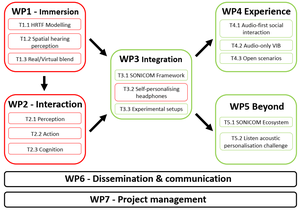
    SONICOM deals with the way we interact socially within AR/VR environments. It will create a new generation of immersive audio technologies and techniques, specifically looking at personalisation and customisation of the audio rendering by means of machine-learning techniques. Using a data-driven approach it will explore, map, and model how the physical characteristics of spatialised auditory stimuli can influence observable behavioural, physiological, kinematic, and psychophysical reactions of listeners within social interaction scenarios.

    SONICOM is a five-year research project funded under the Horizon2020 FET Proactive. It involves an international team of ten research institutions and creative tech companies from six European countries, with Lorenzo Picinali (Imperial College, London, UK) as the project coordinator. More details can found at the SONICOM website: https://www.sonicom.eu

    Project

    The SONICOM project receives funding from the European Union’s Horizon 2020 research and innovation programme under grant agreement #101017743

    Verlag der Österreichischen Akademie der Wissenschaften
    Austrian Academy of Sciences Press
    A-1011 Wien, Dr. Ignaz Seipel-Platz 2
    Tel. +43-1-515 81/DW 3420, Fax +43-1-515 81/DW 3400
    https://verlag.oeaw.ac.at, e-mail: verlag@oeaw.ac.at

    Bestellung/Order


    Bild
    SONICOM


    Send or fax to your local bookseller or to:

    Verlag der Österreichischen Akademie der Wissenschaften
    Austrian Academy of Sciences Press
    A-1011 Wien, Dr. Ignaz Seipel-Platz 2,
    Tel. +43-1-515 81/DW 3420, Fax +43-1-515 81/DW 3400
    https://verlag.oeaw.ac.at, e-mail: bestellung.verlag@oeaw.ac.at
    UID-Nr.: ATU 16251605, FN 71839x Handelsgericht Wien, DVR: 0096385

    Bitte senden Sie mir
    Please send me
     
    Exemplar(e) der genannten Publikation
    copy(ies) of the publication overleaf


    NAME


    ADRESSE / ADDRESS


    ORT / CITY


    LAND / COUNTRY


    ZAHLUNGSMETHODE / METHOD OF PAYMENT
        Visa     Euro / Master     American Express


    NUMMER

    Ablaufdatum / Expiry date:  

        I will send a cheque           Vorausrechnung / Send me a proforma invoice
     
    DATUM, UNTERSCHRIFT / DATE, SIGNATURE

    BANK AUSTRIA CREDITANSTALT, WIEN (IBAN AT04 1100 0006 2280 0100, BIC BKAUATWW), DEUTSCHE BANK MÜNCHEN (IBAN DE16 7007 0024 0238 8270 00, BIC DEUTDEDBMUC)
    Bild

    Towards modelling active sound localisation based on Bayesian inference in a static environment

      Glen McLachlan, Piotr Majdak, Jonas Reijniers, Herbert Peremans

    Sonicom Publications, pp. , 2022/04/21

    TRANSFORMING AUDITORY-BASED SOCIAL INTERACTION AND COMMUNICATION IN AR/VR

    doi: https://doi.org/10.1051/aacus/2021039

    PDF
    X
    BibTEX-Export:

    X
    EndNote/Zotero-Export:

    X
    RIS-Export:

    X 
    Researchgate-Export (COinS)

    Permanent QR-Code

    doi:https://doi.org/10.1051/aacus/2021039

    Abstract

    Over the decades, Bayesian statistical inference has become a staple technique for modelling human multisensory perception. Many studies have successfully shown how sensory and prior information can be combined to optimally interpret our environment. Because of the multiple sound localisation cues available in the binaural signal, sound localisation models based on Bayesian inference are a promising way of explaining behavioural human data. An interesting aspect is the consideration of dynamic localisation cues obtained through self-motion. Here we provide a review of the recent developments in modelling dynamic sound localisation with a particular focus on Bayesian inference. Further, we describe a theoretical Bayesian framework capable to model dynamic and active listening situations in humans in a static auditory environment. In order to demonstrate its potential in future implementations, we provide results from two examples of simplified versions of that framework.

    Keywords: Sound localisation, Active listening, Dynamic cues, Bayes, Models